Capital One: Q1/2025 Property Transfer Volumes Decline – Buying Power Slows Despite Government Support
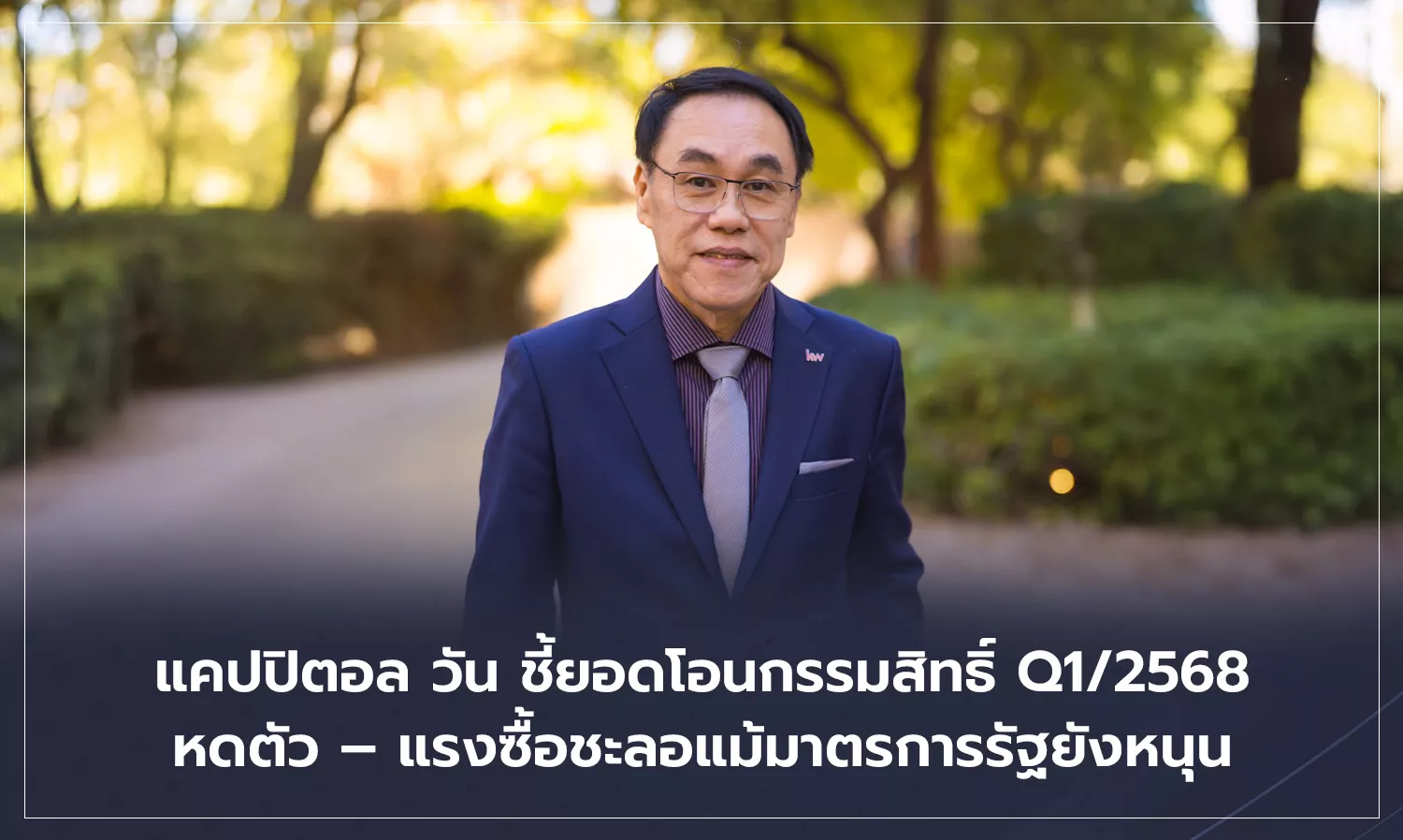
Capital One Real Estate Co., Ltd. warns that the Thai real estate market in the first quarter of 2025 is facing significant pressure, with new loan volumes contracting by 20.5%, the lowest in 25 quarters. The government is urged to implement proactive measures to support recovery.
Mr. Wit Kulthanwiphat, CEO of Capital One Real Estate Co., Ltd. and Keller Williams Thailand, revealed that the Thai real estate market is clearly trending downward in the first quarter of 2025, despite previous government stimulus measures. The uncertainty of the global economic situation, particularly the United States' reciprocal tariffs, has impacted the global economic chain, directly affecting Thailand as an exporting country.
“Unclear trade negotiations with the U.S. have affected the confidence of both investors and consumers, especially in the real estate sector, which is highly sensitive to economic stability. This has caused customers to delay purchasing decisions and developers to postpone launching new projects,” Mr. Wit stated.
If Thailand faces import tariffs from the U.S. on essential construction materials such as air conditioning systems, solar energy equipment, or decorative materials, costs may rise, putting pressure on housing prices to increase even as demand has not yet recovered. This could impact investments from U.S. allied countries that are assessing the economic risks in Thailand more critically.
Baht Volatility – Investors Delay Purchases
Data from early 2025 indicates that the Thai baht has been continuously volatile, strengthening to 33.29 baht per U.S. dollar in April, creating uncertainty for foreign investors, particularly from China, Singapore, and Hong Kong, who often calculate investments in foreign currencies. This currency volatility has become a significant obstacle.
Tight Lending – High DSR Limits Access to Housing
Additionally, there are issues with strict lending policies, with the rejection rate for housing loans in 2023 reaching 60-65%, and the trend is not expected to decrease in 2024-2025, particularly for homes priced under 3 million baht, which clearly affects middle to low-income earners. New loan volumes in the first quarter of this year decreased by 20.5%, the lowest in 25 quarters, amounting to 121 billion baht. The number of property transfers nationwide in the first quarter of 2024 contracted by 13.8% compared to the same period last year, with the most affected price range being 5.01-7.5 million baht, which saw a 20% decline.
However, the banks' debt service ratio (DSR) calculation standards affect loan approvals for housing purchases. Many clients with stable incomes are denied loans because their DSR exceeds the threshold of 40-50% due to non-income-generating debts, such as credit cards or installment purchases, resulting in lost opportunities to buy homes. I personally propose a new approach to separate DSR into two categories: housing debt (DSR1) with a maximum of 40-45% and consumer debt, such as credit cards and installment purchases (DSR2), limited to 15-20% of income. This would keep the total DSR below 60% according to banking risk frameworks while making it easier for borrowers to purchase homes without being burdened by unnecessary debt.
“This approach will help more citizens have the opportunity to own homes without bearing the burden of managing unrelated debts,” Mr. Wit emphasized.
Call for Government to Implement Proactive Measures
Given that real estate accounts for as much as 20% of the country's GDP, the government is urged to consider urgent proactive measures such as:
1. Allowing home loan interest expenses to be fully deductible for tax purposes, enabling buyers to deduct income tax from interest paid over 10 years.
2. Increasing the number of foreign buyers by considering cash purchases of real estate, reducing the minimum investment requirement for Retirement property under the LTR Visa to 150,000 USD or approximately 5,000,000 baht, down from the current 250,000 USD, which is excessively high compared to other countries that attract foreign investors to purchase real estate.
3. Launching a “Special Low-Interest Home Loan for the First 3 Years” program in collaboration with state or private banks to offer special loans at interest rates of 1.99-2.5% for the first three years. Currently, such initiatives exist but are limited in number, making them ineffective in stimulating the market.
4. Establishing a government policy for “Shared Equity” of 10% of the home price, which would reduce the loan amount and lower monthly payments. Upon selling the home, the government would only reclaim the original proportion and charge interest at the policy rate.
Therefore, the government must recognize that 2025 is a challenging year for the real estate market. Without sufficient targeted measures, the slowdown will worsen and negatively impact the overall economy in the long term.